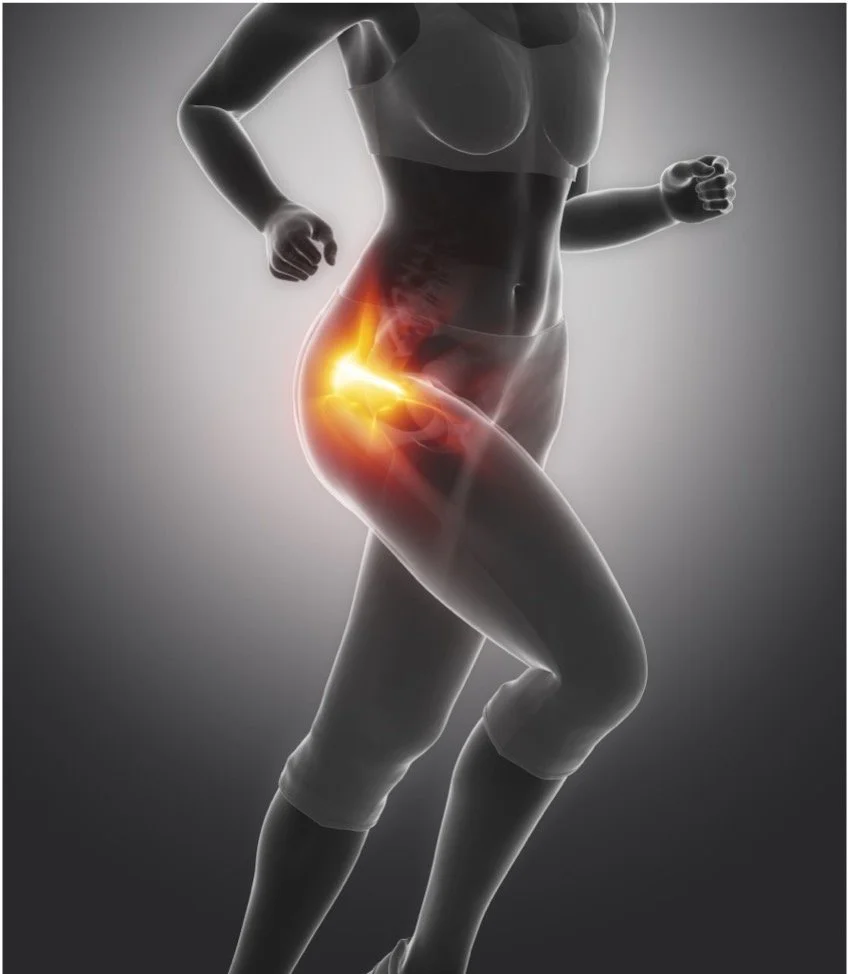
Pain on the outside of your hip?
Pain on the outside of the hip is one of the most common reasons people over 40 see a hip specialist. It is often called "bursitis", but in most cases the real cause is a problem with the gluteal tendons, which attach the buttock muscles to the side of the hip bone.
The good news is that most people get better without surgery, as long as the problem is correctly diagnosed and treated in the right way.
Does this sound like you?
Pain on the outside of the hip, sometimes spreading down the side of the thigh
Pain when lying on the affected side, or on the other side with the knees together
Pain and weakness when climbing stairs, getting up from a chair or walking any distance
Pain when standing on one leg, for example putting on trousers
Tenderness when pressing on the bony point at the side of the hip
It is particularly common in women around and after the menopause, but affects men too. It can follow a change in activity or a fall, or start for no obvious reason.
What causes it?
The gluteal tendons can become irritated and weakened over time, a condition called gluteal tendinopathy, sometimes described as greater trochanteric pain syndrome. In some people the tendon partly or completely tears away from the bone, which can cause a limp and weakness as well as pain.
Because hip arthritis, back problems and tendon problems can all cause similar pain, an accurate diagnosis is the first and most important step.
How is it diagnosed?
Mr Raymond will take a detailed history and examine your hip, back and walking pattern. Where needed, an X-ray or MRI scan can show the condition of the hip joint, hip bone and tendons, and whether there is a tear. Scans can usually be arranged at short notice at the Nuffield Health Bournemouth Hospital or the Circle Harbour Hospital.
Treatment without surgery
Most people with gluteal tendinopathy improve without an operation. Treatment usually includes:
Understanding the condition: simple changes to how you sleep, sit and stand can reduce the load on the tendon
Targeted physiotherapy: a progressive strengthening programme is the most effective long-term treatment, and Mr Raymond works with local physiotherapists experienced in this condition
Injections: where pain is holding back progress, an injection, including platelet-rich plasma (PRP), can help
When surgery may help
Surgery is considered when a significant tendon tear is confirmed, or when symptoms remain despite a full course of appropriate treatment. The operation reattaches the torn tendon to the bone, sometimes with reinforcement.
Recovery takes time, as the tendon needs to heal back onto the bone. Most patients use crutches for around six weeks and follow a structured rehabilitation programme, with improvement continuing for several months. Mr Raymond will discuss what to expect in your situation.
Why see Mr Raymond?
Mr Raymond is a consultant hip surgeon with a specialist interest in soft tissue problems around the hip, including gluteal and hamstring tendon repair. Because he treats the full range of hip conditions, from non-surgical care to tendon repair, resurfacing and hip replacement, he can identify the true cause of your pain and recommend the treatment that suits you, which for most people will not be an operation.
Book a consultation
Self-funding patients do not need a GP referral. If you are insured, check with your insurer first, as most require a GP referral and an authorisation code.
Contact Mr Raymond's secretary, Lisa Green, on 07879 982891 or at lisa@consultantadmin.co.uk. Mr Raymond sees patients at the Nuffield Health Bournemouth Hospital and the Circle Harbour Hospital, Poole.